Viggo Brunprisen 2024 skal deles ut under Norsk Matematikermøte i Oslo 12.-13. september.
Nominasjoner bes sendt til mailto:nmf@matematikkforeningen.no innen 1. april 2024.
Statutter: https://web.matematikkforeningen.no/viggo-brun-prisen/

Viggo Brunprisen 2024 skal deles ut under Norsk Matematikermøte i Oslo 12.-13. september.
Nominasjoner bes sendt til mailto:nmf@matematikkforeningen.no innen 1. april 2024.
Statutter: https://web.matematikkforeningen.no/viggo-brun-prisen/
Fredag 15/9 avholdes årsmøte i Norsk Matematisk Forening, med inviterte foredrag, lunch, middag og generalforsamling!
Sted: Hotel Terminus, Bergen, https://www.grandterminus.no/
Påmelding innen 12/9, nødvendig for deltakelse i Lunch / Middag:
https://docs.google.com/forms/d/1OFiSEsMTBEEhbxd-NoVgNhsL1HSgwZEbICidHk-MRhQ/
Generalforsamling:
Tid: Fredag 15/9/2023 kl. 16:30
Sted: Hotel Terminus, Bergen
Dokumenter for generalforsamlingen:
https://web.matematikkforeningen.no/2023/09/05/dokumenter-til-gf-nmf-15-9-2023/
Program for dagen:
Inviterte forelesninger, Hotel Terminus, fra 11:15:
11:15-12:05: Kris Shaw, TBA
12:05-13:00: Lunch.
13:00-13:50: Ragni Piene, “Curve counting and generating functions”
13:50-14:40: Kundan Kumar, “Free Boundary Problems and contributions of Luis Caffarelli, Abel Laureate 2023”
14:40-15:10: Coffee break.
15:10-16:00: Gereon Quick, “On counting and adding points quadratically”
16:30- end : Generalforsamling NMF, Hotel Terminus, Bergen
18:00 Middag, Hotel Terminus, Bergen
Abstrakter:
Kris Shaw, UiO: TBA.
Ragni Piene, UiO: “Curve counting and generating functions”
A classical problem in enumerative geometry is to determine how many plane curves of given degree and with given types of singularities pass through some fixed points. For example, there is 1 non-singular cubic passing through 9 points, but 12 singular cubics passing through 8 points. Such curve counting problems have received new attention because of their appearance in string theory in theoretical physics.
There is currently no closed formula solution to the above general problem. However, as I will explain, in some cases one can determine the generating function: a formal power series whose coefficients are the desired solutions.
Kundan Kumar, UIB:
“Free Boundary Problems and contributions of Luis Caffarelli, Abel Laureate 2023”
Abstract: Luis Caffarelli, recipient of the Abel Prize 2023, is one of the most prolific (>350 papers with 150 collaborators) and outstanding mathematicians (having received several prizes including 2018 Shaw Prize) of current times. His main field is in the regularity of solutions for partial differential equations (PDEs) and he has made deep contributions to several areas of PDEs including free boundary problems, fully nonlinear equations, homogenization, and nonlocal equations. I will introduce Free Boundary Problems and briefly discuss his contributions in this area.
Gereon Quick, NTNU: “On counting and adding points quadratically”
Abstract: The Brouwer degree of a map is a classical and fundamental invariant in topology. It may be defined by counting points in the fiber. By taking additional algebraic information of maps into account one can define a Brouwer degree in algebraic geometry. In my talk I will introduce the ideas and computations relevant for an algebraic Brouwer degree and will discuss why this is important. I will then report on joint work with Viktor Balch Barth, William Hornslien and Glen Matthew Wilson on how one can make certain abstractly defined group structures very explicit. My focus will be on presenting a general picture rather than the details.
The Viggo Brun Prize for 2022 is awarded to:
Nina Holden
for her exceptionally deep and broad contributions to probability theory, especially for her work on random surfaces and quantum gravity in two dimensions.
Nina Holden (born 1986) is a Norwegian mathematician with MSc from the University of Oslo in 2010 and PhD from the Massachusetts Institute of Technology in 2018. She is currently a Post-Doc at ETH Zürich and has accepted a position as Associate Professor at the Courant Institute of Mathematical Sciences, New York University, starting in fall 2022. In 2021 Nina Holden was honored with the Maryam Mirzakhani New Frontiers Prize.
Holden’s research field is probability theory. She has successfully pursued an impressive number of topics: Liouville Quantum Gravity (LQG), Schramm–Loewner evolutions (SLE), random planar maps, statistical physics, data reconstruction, graphons, fine properties of Brownian motion, the Schelling model, and more. Her results are of theoretical nature, but have important implications in theoretical physics (conformal field theory, string theory, the understanding of gravity), as well as real-world phenomena such as phase transitions for random systems. Her proofs involve a wide variety of different techniques and ideas.
Holden’s perhaps most remarkable achievement, for which she was awarded the Maryam Mirzakhani New Frontiers Prize, concerns the convergence of uniform random planar triangulations (URPT) to LQG. Physicists have believed, since at least the 1980s, that if one takes an appropriate limit of large number of vertices of the URPT, one should obtain some form of convergence to LQG. In other words, just as discrete random walks converge to continuum random paths of Brownian motion, it should be the case that discrete random surfaces converge to continuum random surfaces.
In joint work with Xin Sun, Holden establishes this fact in a very precise way. They prove that if uniformly random planar triangulations are embedded in the plane via the so called Cardy embedding, then the embedded map converges to LQG. This result and various ramifications span six publications, with several co-authors, that are noteworthy in their own right and that have been published or accepted for publication in highest level journals such as Memoirs of the American Mathematical Society, Annales de l’Institut Henri Poincaré and Acta Mathematica.
In addition to the monumental results related to the Cardy embedding, Holden also has several other impressive achievements, in particular within the broad subject of conformal probability, from which we give some samples:
In “A distance exponent for Liouville quantum gravity”, with E. Gwynne and X. Sun, Probability Theory and Related Fields (2018), she has made some of the most important progress on the still somewhat mysterious problem of understanding distance functions on Liouville quantum gravity surfaces.
The paper “SLE as a mating of trees in Euclidean geometry”, with X. Sun, Communications in Mathematical Physics (2018), explains a fundamental property of the scaling limit of a uniformly random spanning tree, namely that it is in some sense determined by the structure of the graph itself.
The paper “An almost sure KPZ relation for SLE and Brownian motion”, with E. Gwynne and J. Miller, Annals of Probability (2020), provides a very general way to understand dimensions of random fractals arising in conformal probability, many related to statistical physics models.
In “Brownian motion correlation in the peanosphere for κ > 8”, with E. Gwynne, J. Miller and X. Sun, Annales de l’Institut Henri Poincar ́e (2017), an answer is given to a fundamental question asked by Miller and Sheffield in one of their papers.
The paper “Conformal welding for critical Liouville quantum gravity”, with E. Powell, Annales de l’Institut Henri Poincaré (2021), solves a problem about SLE and the conformal welding theory of LQG surfaces by extending the γ < 2 theory to the critical γ = 2 case.
In “Dimension transformation formula for conformal maps into the complement of an SLE curve”, with E. Gwynne and J. Miller, Probability Theory and Related Fields (2019), a formula is proved relating the Hausdorff dimension of a deterministic Borel subset of R and the Hausdorff dimension of its image under a conformal map from the upper half-plane to a complementary connected component of an SLE curve.
Outside of conformal probability, Holden has solved, in “How round are the complementary components of planar Brownian motion?”, with S. Naçu, Y. Peres,and T. S. Salisbury, Annales de l’Institut Henri Poincaré (2019), one of the more fundamental questions about the complementary components of planar Brownian motion, namely the extent to which they tend to be “round”, that is, have area on the same order of the square of their diameter. In the well-cited and recognized “Sparse exchangeable graphs and their limits via graphon processes”, with C. Borgs, J. T. Chayes and H. Cohn, Journal of Machine Learning Research (2018), so–called graphons are studied, which constitute an approach to large dense graphs. In addition, Holden has obtained interesting results on trace reconstruction problems for random strings and deletion probabilities in “Trace reconstruction with varying deletion probabilities”, with L. Hartung and Y. Peres, Analytic Algorithmics and Combinatorics (ANALCO) (2018), and in “Subpolynomial trace reconstruction for random strings and arbitrary deletion probability”, with R. Pemantle and Y. Peres, Conference On Learning Theory (COLT) (2018). The problems in this area involve the extent to which one can recover information about a string of characters when some of the characters have been randomly removed.
In conclusion, Holden’s research record is truly astonishing, with papers of exceptional depth and breadth published in first class journals, and she has very rapidly established herself as one of the leading researchers in probability theory at highest international level.
The board of the Norwegian Mathematical Society and the Norwegian National Committee for Mathematics has on February 27, 2022 issued the following statement concerning the invation of Ukraine and the upcoming ICM and IMU General Assembly:
«Mathematicians in Norway have been looking forward to celebrating mathematics this summer with people from around the world in Saint Petersburg, a city with a long and important tradition in mathematics. We strongly condemn the Russian government’s brutal invasion of Ukraine and we support IMU’s decision not to hold the 2022 International Congress of Mathematicians (ICM 2022) in Saint Petersburg.
Our thoughts are with our colleagues and the people in Ukraine suffering from the ongoing war and also with our colleagues and the people in Russia who are protesting against these unlawful actions of their government.»
«Norske matematikere har sett fram til å feire matematikk i sommer sammen med mennesker fra hele verden i Sankt Petersburg, en by med lange og viktige matematiske tradisjoner. Vi fordømmer på det sterkeste den russiske regjeringens brutale invasjon av Ukraina og vi støtter IMUs avgjørelse om å ikke avholde den internasjonale matematikkongressen i Sankt Petersburg.
Våre tanker er med våre kolleger og det ukrainske folk som lider under den pågående krigen og også med våre kolleger og alle i Russland som protesterer mot disse ulovlige handlingene begått av deres styresmakter.»
Yours sincerely,

Hans Z. Munthe-Kaas
President of the Norwegian Mathematical Society
Vi ber om at alle som ønsker å avholde Abelsymposium 2023 sender en skisse til mailto:nmf@matematikkforeningen.no innen 1. september 2023.
Styret i NMF vil velge ut en av skissene og gi i oppgave å utarbeide en full søknad.
Skissen bør inneholde:
Viggo Brunprisen 2022 skal deles ut under Norsk Matematikermøte i Tromsø 1.-2. september.
Nominasjoner best sendt til mailto:nmf@matematikkforeningen.no innen 20. april 2022.
Statutter: https://web.matematikkforeningen.no/viggo-brun-prisen/
The Viggo Brun Prize 2020 is awarded to John Christian Ottem for his deep and original contributions to algebraic geometry, especially to the theory for birational varieties of higher dimension and to questions concerning positivity and existence of cycles.
John Christian Ottem (born 1985) is a Norwegian mathematician with a bachelor and a master degree from the University of Oslo. His PhD degree is from the University of Cambridge in 2013, where his advisor was Burt Totaro. Ottem held a post doc position at the University of Cambridge from 2013 to 2016. In 2016 he became an associate professor – and in 2019 a professor – at the University of Oslo.
Ottem’s research is within algebraic geometry. His work shows large breadth and originality. He obtains deep results, both alone and in collaboration with others, and publishes in very good, general mathematical journals. The prob- lems he chooses are often classical, but he attacks and solves them by using sophisticated modern techniques.
Ottem has contributed to three of “hottest” problems in algebraic geometry: higher dimensional birational geometry, the Hodge conjecture, and Hartshorne’s conjecture.
The study of cycles on projective varieties is a recurring theme in Ottem’s research, in particular in connection with properties like ampleness and positiv- ity. His two first papers, wwritten when he was a master student, were about Cox rings of certain algebraic surfaces. In his PhD thesis he studied ample sub- varieties and line bundles on projective varieties and the relationship between ampleness and positivity. In an article published in the Journal of the European Mathematical Society Ottem studies subvarieties with ample normal bundle in a smooth projective variety. In codimension 1 these are positive divisors and well understood, but in higher codimension there are many open questions. Ottem shows that the cohomology classes of curves with ample normal bun- dle are “big” and movable. This has potentially important consequences for Hartshorne’s famous conjecture about complete intersections.
Together with Jørgen Vold Rennemo, Ottem gave the first counterexamples to the socalled “birational Torelli problem” for Calabi–Yau threefolds. This is a well known conjecture about Calabi–Yau threefolds going back to the 1980’s. The article has led to much acitivity in the area of derived equivalent Calabi–Yau manifolds and the Grothendieck ring of varieties.
Among other highlights is a joint work with Olivier Benoist, where they show that the integral version of the Hodge conjecture does not hold for three- folds with Kodaira dimension 0. In another paper they consider Grothendieck’s “coniveau” and “strong coniveau” filtrations on the cohomology groups of a variety and give the first examples where these two filtrations are different.
A joint work with Stefan Schreieder has as its starting point Mori’s question from 1975 on whether smooth deformations of hypersurfaces of prime degree also are hypersurfaces. Ottem and Schreieder give a positive answer to this question for quintic hypersurfaces of arbitrary dimension and septic hypersurfaces of dimension three. A corollary of their results is a famous theorem of Horikawa concerning deformations of quintic surfaces.
In collaboration with Johannes Nicaise, Ottem considers the classical prob- lem of determining which hypersurfaces are rational, i.e., birationally equivalent to a projective space. Nicaise and Ottem use motivic obstruction to show the existence of several new classes of stably irrational hypersurfaces and complete intersections. An important ingredient is tropical degeneration techniques. In another joint work they construct a refinement of motivic volume, which general- izes the version of motivic volume due to Nicaise and Schinder and the birational version due to Kontsevitch and Tschinkel. They show how their techniques give rise to explicit examples of obstructions to stable rationality.
The Viggo Brun Prize 2018 is awarded to
Rune Gjøringbø Haugseng
For fundamental contributions to the theory of higher categories, with applications to quantum field theory, representation theory, algebraic geometry, and geometric topology, and for the development of higher Morita theory and enriched ∞-categories.
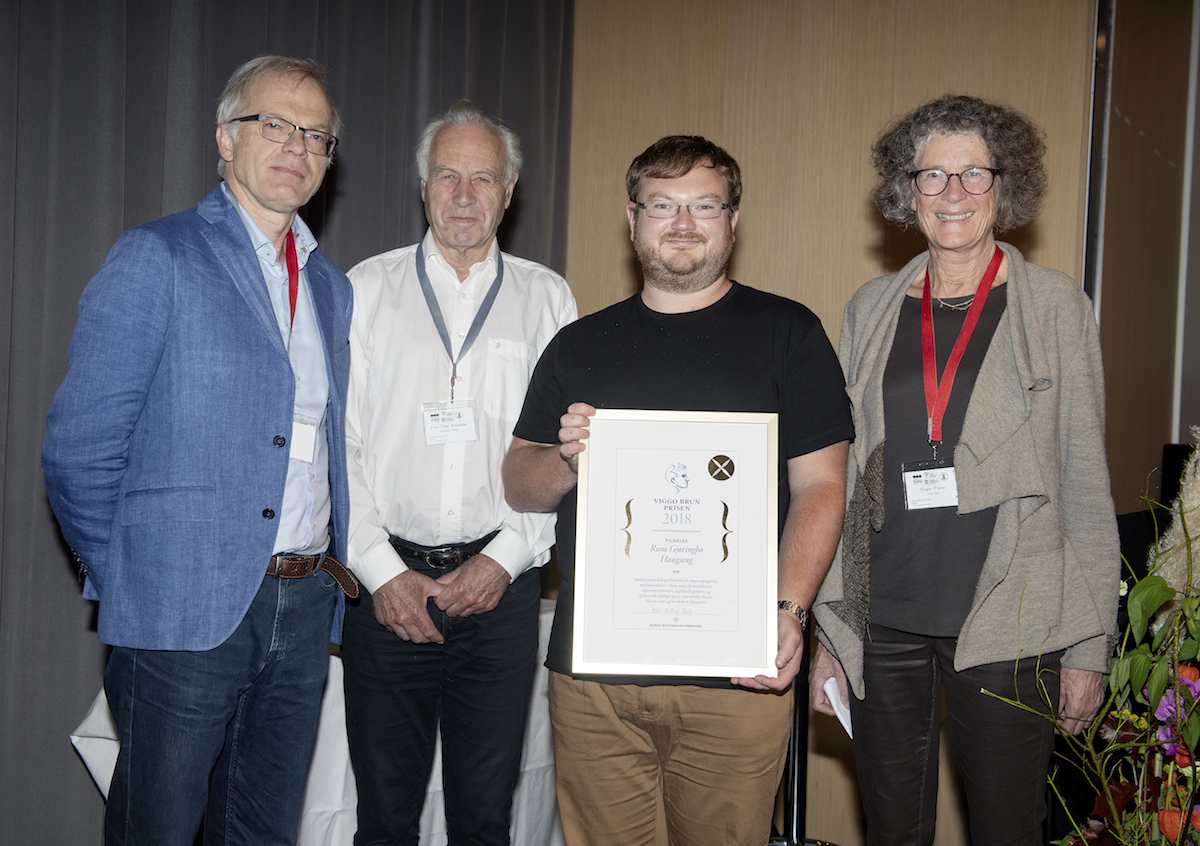
Kristian Seip, Finn Faye Knudsen, Rune Haugseng, Ragni Piene
Photo: Helge Skodvin
Rune Haugseng (born 1984) is a Norwegian mathematician with BA and MA degrees from Cambridge University. He earned a PhD from Massachusetts Institute of Technology in 2013 with Haynes Miller as supervisor. He has held post-doc positions at the Max Planck Institute for Mathematics in Bonn and at the University of Copenhagen. Starting in the fall of 2019 he will be an associate professor at NTNU.
Haugseng studies higher categories. These are structures that occur in many places in mathematics where some property typically only holds up to (a hierarchy of) equivalences that have to fit together.
As an example, parts of Haugseng’s work give contributions to topological quantum field theories. Quantum field theories associate to space-time (geometry) its state space (algebra) with a time-evolution operator. However, the global structure should be governed by the local information. To make this into a mathematically acceptable theory has proven to be a challenge, keeping mathematicians busy for decades. The problem is that many things interact in a way that yields an enormously complicated system of coherence problems. Parts of Haugseng’s work also have direct connections to derived algebraic geometry where similar phenomena occur.
Among Haugseng’s many important works, there are two monumental contributions: A groundbreaking 140-page joint paper with David Gepner, published in Advances in Mathematics, develops the theory of enriched ∞-categories, and in a 100-page paper in Geometry & Topology, Haugseng solves the central problem of how to construct a higher version of the Morita category of associative algebras, bimodules, and bimodule homomorphisms. Haugseng’s set-up provides a context for factorization homology, a topological variant of Beilinson–Drinfeld’s chiral homology proposed by Jacob Lurie. Given an En algebra (an algebra where commutativity holds up to “level n”) factorization homology gives rise to a topological quantum field theory for n-dimensional manifolds.
Haugseng’s pioneering work provides a platform for realizing several existing strategies for attacking central conjectures. Haugseng himself should be ideally placed to grasp these opportunities.
In addition to developing new theory, Haugseng has also given important contributions by consolidating different competing theories.
In conclusion, Haugseng is an outstanding young mathematician who combines his profound insight with brute mathematical force within an active and highly competitive field.
Viggo Brun-prisen for 2018 tildeles
Rune Gjøringbø Haugseng
for hans banebrytende bidrag til teorien for høyere kategorier, med anvendelser i blant annet kvantefeltteori, representasjonsteori, algebraisk geometri og geometrisk topologi, og for å ha utviklet høyere Morita-teori og berikede ∞-kategorier.
Kristian Seip, Finn Faye Knudsen, Rune Haugseng, Ragni Piene
Foto: Helge Skodvin
Rune Haugseng (født 1984) er en norsk matematiker med bachelor- og master-utdanning fra Cambridge University og med ph.d. fra Massachusetts Institute of Technology i 2013, der han hadde Haynes Miller som veileder. Han har vært ansatt som postdoktor ved Max Planck Institute for Mathematics i Bonn og ved Københavns Universitet. Høsten 2019 tiltrer han som førsteamanuensis ved NTNU.
Haugseng studerer høyere kategorier. Dette er strukturer som dukker opp mange forskjellige steder i matematikken der en egenskap typisk bare holder opp til (et hierarki av) ekvivalenser som skal passe sammen.
For eksempel er deler av Haugsengs arbeid bidrag til topologisk kvantefeltteori. Kvantefeltteorier tilordner til tid-rommet (geometri) dets tilstandsrom (algebra) med en tidsutviklings-operator. Dette skal skje på en måte der sammensetningen av den lokale informasjonen bestemmer det globale. Å gjøre dette til en matematisk tilfredsstillende teori viser seg å være en formidabel oppgave som har opptatt matematikere i tiår. Problemet er at mange ting griper inn i hverandre og gir et uhyre komplekst system av koherensproblemer. Deler av Haugsengs arbeider har også direkte koblinger til derivert algebraisk geometri der tilsvarende fenomener er en del av teorien.
Blant Haugsengs mange viktige arbeider er det to monumentale bidrag: I et 140-siders banebrytende fellesarbeid med David Gepner, publisert i Advances in Mathematics, utvikler de teorien for berikede ∞-kategorier, og i et 100-siders arbeid, publisert i Geometry & Topology, løser Haugseng det sentrale problemet om hvordan konstruere en høyere versjon av Morita-kategorien av assosiative algebraer, bimoduler og bimodul-homomorfier. Haugsengs arbeid gir en kontekst for faktoriseringshomologi, en topologisk variant av Beilinson–Drinfelds kiralhomologi fremmet av Jacob Lurie. Gitt en En-algebra (en algebra der kommutativitet holder opp til “nivå n”) gir faktoriseringshomologi opphav til en topologisk kvantefeltteori for n-dimensjonale mangfoldigheter.
Haugsengs nyvinninger gir en plattform for å virkeliggjøre eksisterende strate- gier slik at sentrale formodninger kan angripes for alvor. Haugseng står selv i en unik posisjon til å utnytte denne muligheten.
Ved siden av å utvikle ny matematikk har Haugseng også kommet med vesentlige bidrag til fagfeltet gjennom å klare opp i forskjeller mellom konkurrerende teorier.
I sum har Haugseng vist seg som en fremragende ung matematiker som evner å kombinere sin gjennomtrengende innsikt med rå matematisk kraft i et svært aktivt og kompetitivt forskningsområde.
 Norsk matematisk forening